Robotics and machinery · ISO 10218 and ISO 13849-1
Robot cell safety software for ISO 10218 and ISO 13849-1
Integrators and robot manufacturers have to show a risk assessment per ISO 12100, a required performance level for every safety function, a safety requirements specification and PL verification for each subsystem, and the technical documentation the Machinery Regulation (EU) 2023/1230 asks for. That work is hard to keep consistent when the risk table, the safety-function list and the SISTEMA calculation live in three files.
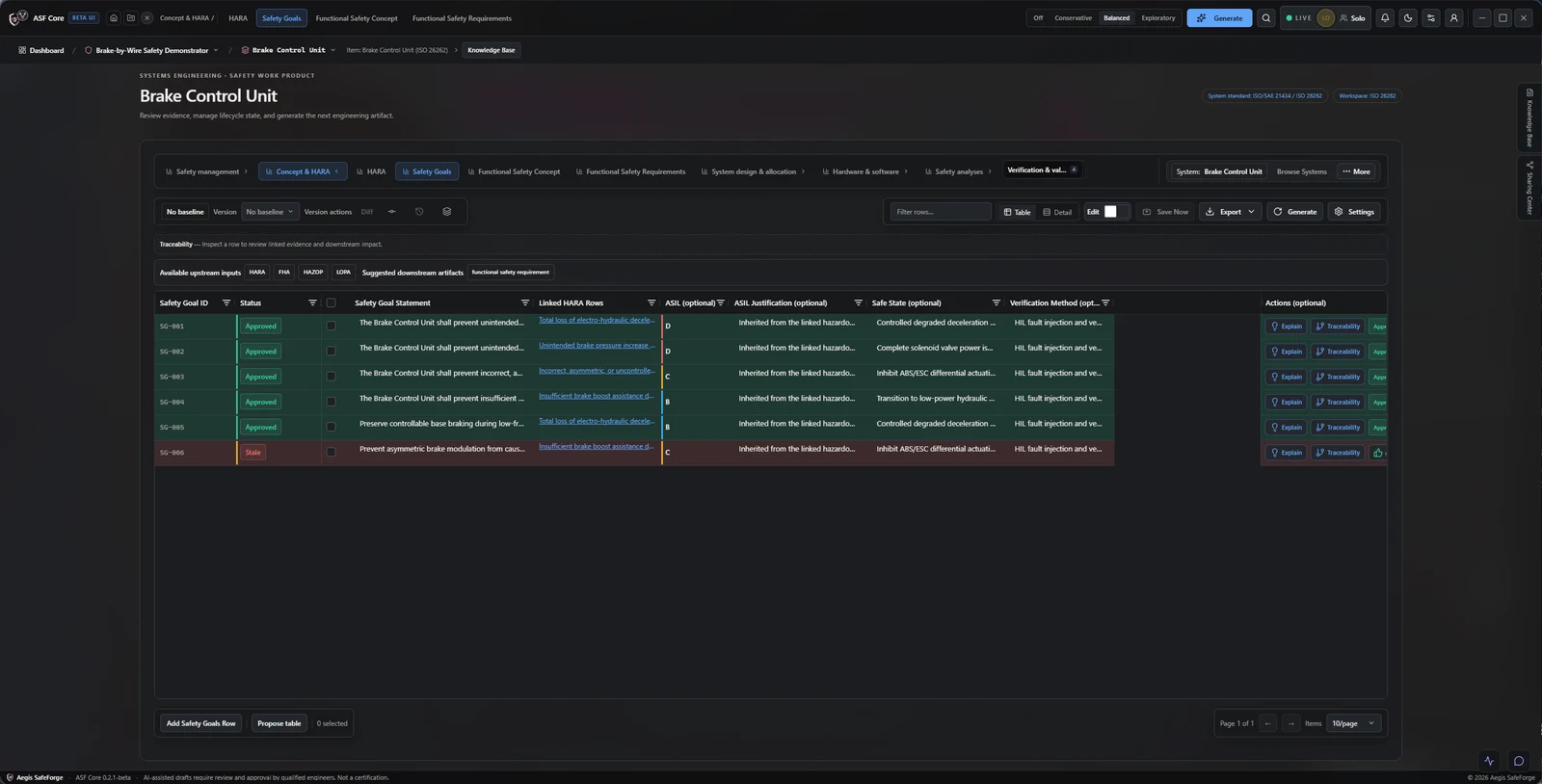
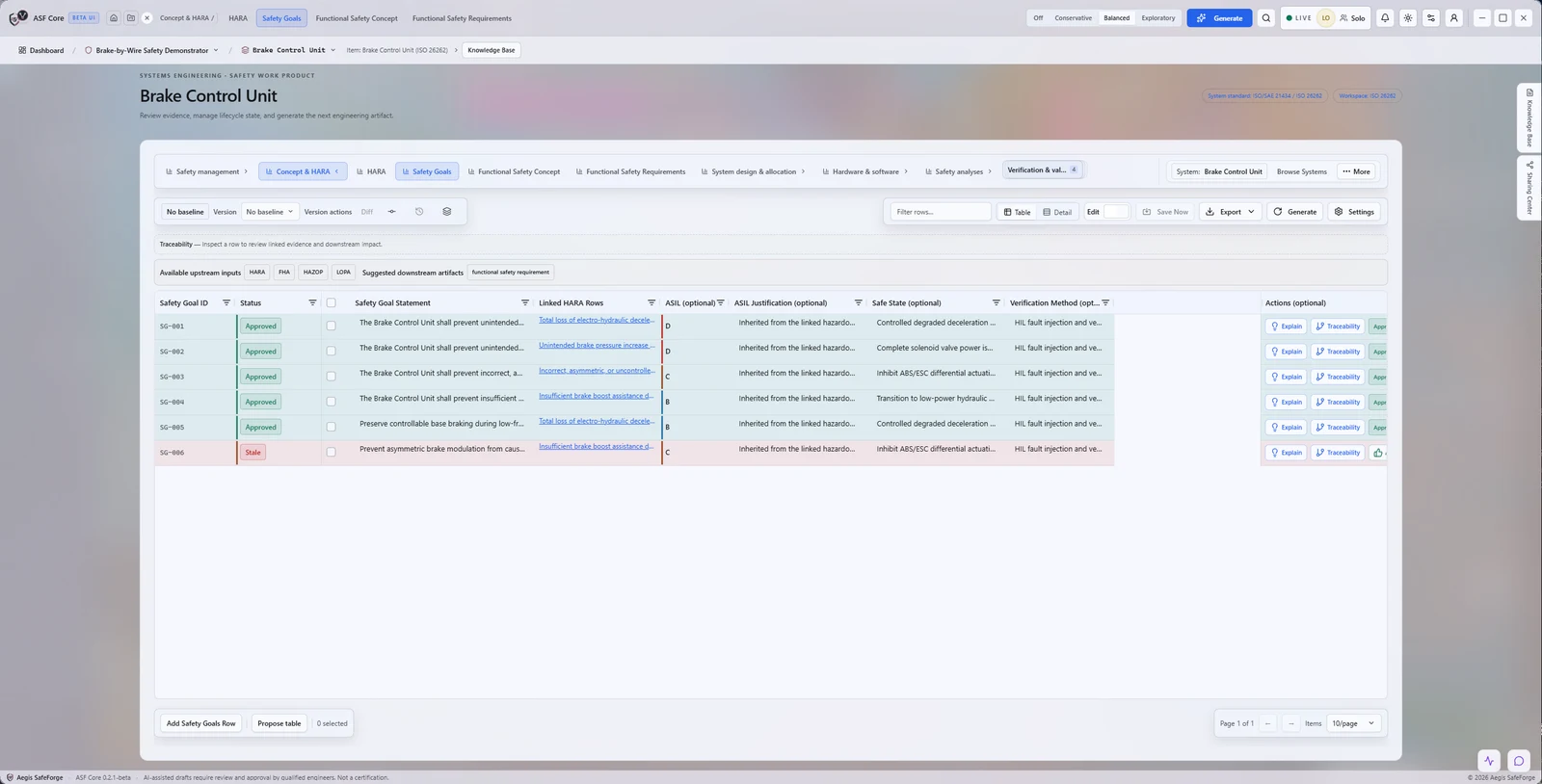
The challenge
The robot cell safety challenge
ISO 10218-1 and -2 (2025 editions) define 39 safety functions with required PL per robot class and mode, from emergency and protective stop to speed and separation monitoring and power and force limiting. Each one needs a traceable PLr derivation, a subsystem architecture with category, MTTFD, DCavg and CCF, and validation evidence. Collaborative applications add task and detection zones, contact cases and limits that change with the application.
With ASF Core
How ASF Core helps
ASF Core carries a robotics profile that keeps the risk assessment, safety functions, SRS, subsystems and validation records in one workspace, with AI drafts proposed from your cell description and standards, and every value approved by a named engineer.
- Capture the robot, end effector, workpiece, spaces (maximum, restricted, operating, safeguarded), modes and collaborative methods once in the item definition.
- Draft risk-assessment rows with ISO 12100 severity, exposure, occurrence and avoidance, and derive the required PL per safety function via ISO 10218 Annex C or the ISO 13849-1 risk graph, with deviations recorded and reviewed.
- Specify safety functions and their SRS (function type, triggering event, safe state, response time, modes active) and link them to subsystems with category, MTTFD, DCavg and CCF checks.
- Keep validation per ISO 13849-1 Clause 10 and the Machinery Regulation Annex III clauses traceable to evidence, and export the record for the notified body or your own technical file.
Methodology
From cell description to validated safety functions
The profile follows the order the standards set, so reviewers see the same chain an assessor expects.
- 01
Risk assessment (ISO 12100)
Hazards per task and zone with severity, exposure, occurrence and avoidance; residual risk and measures outside the control system recorded first.
- 02
Safety functions and PLr
Functions from ISO 10218 Annex C with mandatory, conditional or optional status; PLr by table, by risk estimation (ISO 10218-2 Annex C.2) or by the ISO 13849-1 risk graph.
- 03
SRS and subsystems
Safety requirements specification per function, subsystems with category and designated architecture, component data, MTTFD, DCavg and CCF.
- 04
Validation and documentation
Validation plan and records per ISO 13849-1 Clause 10, information for use, and the technical documentation the Machinery Regulation requires.
Industry profile in ASF Core
- Robotics and machineryISO 10218-1/-2 · ISO 13849-1 · ISO 12100 · MR (EU) 2023/1230Risk assessment, safety functions with PLr, SRS and PL verification (new profile)
FMEDA captures inputs and external analysis references; ASF does not calculate PMHF. The value is shown as not computable, with the reason. Safety case, confirmation review, functional safety audit and assessment, configuration baseline and safety release are available as manually maintained work products, without AI generation. Supplier, tool-confidence, reuse and field records support recording and review, without automated qualification or release. Industry profiles do not imply certification or tool qualification.
Supported robotics workflows
Item definition for robot cells · Risk assessment (ISO 12100) · Safety functions with PLr · Safety requirements specification · Subsystem PL verification · Validation records · Collaborative applications (HGC, SSM, PFL)
Continue reading
FAQ
Frequently asked questions
Which robotics standards does the profile cover?
ISO 10218-1:2025 and ISO 10218-2:2025 for industrial robots and robot applications, ISO 13849-1:2023 for the safety-related parts of control systems, ISO 12100 for risk assessment, and the clauses of the Machinery Regulation (EU) 2023/1230 Annex III they map to. IEC 62061 is supported as the alternative functional safety route.
Does ASF Core calculate the achieved performance level?
ASF Core records subsystem category, channel MTTFD, DCavg and CCF and checks them against the ISO 13849-1 rules, including the 100-year MTTFD cap and the Category 2 test-rate conditions. Detailed PFH calculation can still be done in SISTEMA; the values and project reference are kept with the subsystem record.
Can it handle collaborative robot applications?
Yes. The item definition captures the collaborative method (hand guiding, speed and separation monitoring, power and force limiting), task and detection zones and the contact cases, and the risk assessment and safety functions follow from them.
Is the robotics profile at the same maturity as automotive?
The robotics profile is the newest of the three first-offering profiles and is being piloted with design partners now. The automotive item definition and HARA workflows have been checked in an independent ISO 26262 gap analysis; a comparable external review of the robotics profile is planned.
Does the profile replace a notified body or a CE assessment?
No. ASF Core structures the risk assessment, safety functions and evidence and keeps the decisions traceable. Conformity assessment, CE marking and any notified-body involvement stay with the manufacturer or integrator.
Compare ASF Core with your current process.
Bring one real bottleneck: HARA, TARA, traceability or evidence. We will show how ASF Core fits your process.